After a stroke, a common cause of a stiff, hard-to-control upper limb is something called abnormal co-activation, or coupling; muscles that should fire separately instead fire together, so when you try to do one movement you might get an unwanted second one bundled in with it. The brain’s movement signals have, in effect, become ‘tangled’. A team at Northwestern University, led by Professor Marc Slutzky, has built a retro, 90s-style video game to tackle this effect, and published the results in Neurorehabilitation and Neural Repair in June 2026.
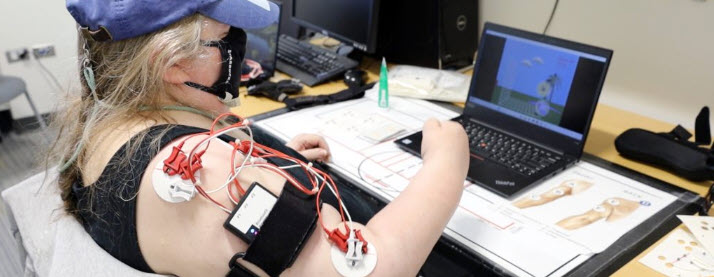
Slutzky’s system, called MINT (myoelectric interface for neurorehabilitation) works like this. You wear a small device on your affected arm that reads the electrical activity of your muscles (the electromyogram, or EMG). Two coupled muscles are each mapped to a direction on screen; say, your biceps moves the cursor right and your deltoid moves it up. If those two muscles are abnormally coupled, they fire together, so the cursor only travels diagonally, up and right at once, like turning both dials on an Etch-a-Sketch simultaneously. The game then places targets further and further off that diagonal, so the only way to reach them is to activate one muscle without the other. To score, you have to decouple. The more the muscles separate, the higher you score, and the separating is the therapy.
The results were strong, though the headline number needs a caveat. Participants were chronic and severely impaired; on average 6.4 years past their stroke, some as much as 12 years out, able to lift the arm a little but not straighten it. After six weeks, the best-performing group improved arm function by 7.8 times as much as a sham control group; to be precise – the impovement group being the group which was given an extra week of training on the most impairing muscles. Across the experimental groups as a whole, the improvement was around 4.5 times the sham group, which the researchers still rate as clinically meaningful. Two further points stand out; the survivors kept improving even after the therapy stopped, and there was a direct correlation between how much the co-activation reduced and how much movement improved, which points to the decoupling as the active ingredient rather than the exercise or the fun of the game.
The access angle is what makes it practically interesting.. because one can play at home, the training volume goes up sharply. Participants managed more than 300 repetitions a day, against perhaps 30 reps, three days a week, in typical clinic-based therapy. ‘Dosage’ sufficiency is acknowledged by experts in upper limb rehab such as Professor Nick Ward at Queen Square, UCL, to be one one of the persistent problems in stroke rehab – he says that most survivors end up getting a ‘homeopathic dose of training’ during their clinical rehab time. A cheap wearable plus a laptop would most probably a survivor rack up reps really easily. It also treats the impairment directly, rather than teaching the survivor to compensate (leaning the whole body forward to reach, say, instead of extending the arm); useful as compensation is, it actually doesn’t improve the arm itself. Slutzky’s team is apparently making the wearable fully wireless, upgrading the games to be more engaging, and is planning to test the same principle on survivors’ lower limbs.