If your arm and hand have been left weak by a stroke, you’ll know it’s often the last thing to recover, and standard rehabilitation has surprisingly little to offer once you plateau. So this pilot trial from the University of Pittsburgh, published in Nature Medicine on 4 June 2026, caught my eye. Seven people with chronic, profound arm weakness got a measurable amount of movement back… using an implant borrowed from a completely different field of medicine.
As you know so well, a stroke damages the brain, not the spinal cord, and that turns out to be the whole basis of the idea. When you go to move your arm, the command still leaves the brain and travels down through the spinal cord to the neurons that fire the muscles; after a stroke those descending signals are badly weakened, but the spinal circuits below are still intact. They’re simply not getting a strong enough command any more. As lead researcher Marco Capogrosso puts it: ‘we’re not substituting anything. We’re just trying to facilitate whatever is left after stroke and help it as much as we can.’
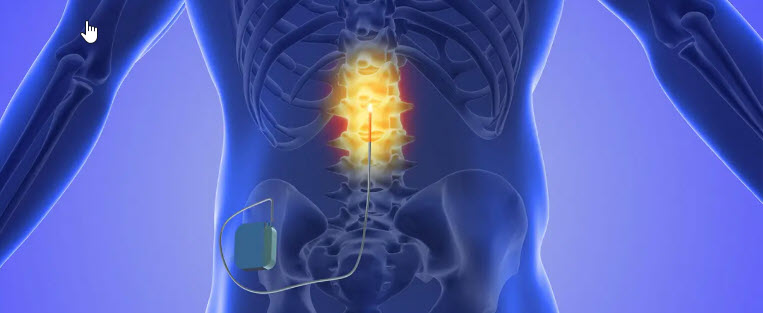
The technique is called cervical epidural spinal cord stimulation. Two thin electrode leads are placed just outside the spinal cord at the neck, over the roots that serve the arm and hand (C3 to T1). The stimulation doesn’t drive the muscles directly; instead it targets the sensory nerve fibres entering the spinal cord (the dorsal-root afferents), and through them raises the excitability of the motor neurons, so the weakened signal still arriving from the brain is now enough to produce movement. The same class of device has been used for decades to treat chronic pain, and is already FDA-approved for that, but this is the first time anyone’s used it to restore arm function after a stroke.
The results, for a small early trial, were well worth having. All seven participants improved, whatever their starting level: an average 32% increase in arm strength, better overall arm mobility, and a reduction in the spasticity (the abnormal muscle stiffness) that so often follows stroke. And all of this came from fewer than nine hours of movement training across four weeks, with no serious side effects and no pain. One participant’s goal was simple: ‘my goal in the beginning was to be able to hug my girlfriend and daughter with both arms. I was able to do that.’ Professor George Wittenberg, a co-author, didn’t hold back: ‘it is like a quantum change in the way that stroke rehabilitation is being handled.’
Two things stand out about it. First, the effect is immediate; switch the stimulation on and the movement improves that moment, which, as Capogrosso notes, is itself a real motivator, because the survivor sees and feels the difference straight away and engages more. Second, it isn’t purely switch-on-switch-off. The stimulation gives an assistive effect while it’s on, but the research also points to a therapeutic effect that builds over time, with some improvement remaining even when it’s off. Btw, the one honest caveat from this feasibility study is that holding onto the gains largely depended on continued stimulation; function declined when the stimulation stopped, which is one of the main questions the next trial is set up to answer.
There’s real reason to take this seriously beyond the small numbers. Around 400,000 people in the US develop chronic arm and hand weakness after stroke every year, and, as Wittenberg says, we’re increasingly comfortable with implanted devices anyway: ‘people already get pacemakers to keep their heart going, so why not have a spinal cord stimulator to keep their movement going?’ The team is now recruiting for a longer trial, testing extended stimulation both on its own and alongside physical therapy, and Capogrosso reckons that, if no major obstacles come up, the technology could be approved for stroke within three to five years. That’s US-based and still some way from your local hospital here of course… but as timelines for this kind of neurotech go, three to five years is not long at all.
At ARNI, the ARNI Instructors and I have always worked on the principle that the arm comes back through intensive, repeated, meaningful practice… and nothing here changes that. What something like this offers is a way to make that practice possible for people whose signal to the muscle is currently just too weak to act on. Interesting stuff, and we’ll be watching where the next trial takes it.