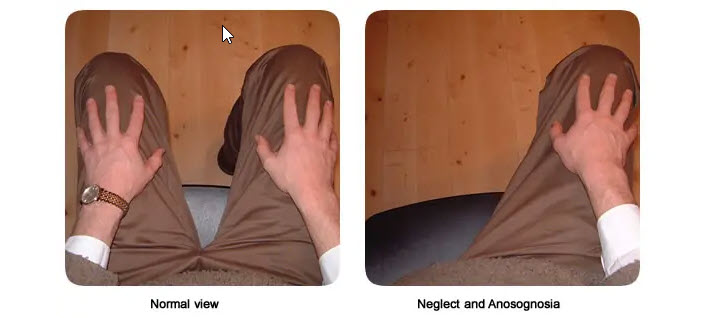

If you’ve had a stroke on the right side of the brain, you may well have come across a problem called spatial neglect, which is where the brain stops attending to everything on your left. It isn’t actually blindness; your eyes work perfectly well, but the brain no longer registers one side of the world. Survivors tend to miss food on the left of the plate, walk into door frames, read only the right half of a page – or don’t see a car coming from the left at a crossing. Neglect is among the most common cognitive effects of stroke, occurring in roughly 38% of survivors, and it’s also one of the strongest signs of a slower, harder recovery, so finding it early can change what comes next.
The trouble is that the usual bedside tests miss a good deal of it. Someone can complete a pen-and-paper cancellation task, or copy a drawing well enough, and still be neglecting their left side out in the daily life where the problem really bites. Conventional screening depends on structured verbal instructions and set tasks, which don’t always reflect how a person behaves when simply looking around a room. And, for survivors whose speech has been affected by the stroke, language-based tests become even harder still to administer fairly.
So a team at the University of Lucerne and the Lucerne Cantonal Hospital, led by Prof Thomas Nyffeler and Dr Brigitte Kaufmann, has spent several years developing a different approach based on eye-tracking, and their latest study (published in Neuropsychological Rehabilitation in 2026) takes it a significant step closer to everyday clinical use. The method is called free visual exploration. You simply look at photographs of ordinary everyday scenes, and an eye-tracker logs where your gaze goes. Someone with neglect explores only the right side of each image and leaves the left almost untouched, and when a clinician maps that gaze as a heat map, the imbalance shows up plainly. As you might imagine, this is far closer to how neglect actually behaves in real life than a tick-box test at the bedside!
What the new study adds is the missing piece that has held eye-tracking back from routine use: proper reference data. The team measured healthy people aged 20 to 89 to establish what normal looks like at every age, so a clinician now has age-appropriate benchmarks to compare a patient against. The overall direction of gaze stayed stable right across adulthood, which means the result holds up whatever a person’s age. When they tested the benchmark from their earlier work, it correctly identified over 95% of healthy participants, so a clinician can read an unusual result with real confidence as a genuine sign of neglect rather than ordinary variation in how people look at a scene. And their earlier research had already shown that clinicians pick up neglect more reliably using free-exploration eye-tracking than with the standard paper-pencil tests.
There are practical reasons this suits stroke survivors particularly well; it’s quick and needs almost no spoken instruction, so it works whatever a person’s first language, and even where speech has been affected by the stroke. And because you can repeat it easily and it gives consistent results over time, a therapist can use it not just to diagnose neglect once, but to track whether it’s improving as rehabilitation goes on. To help other clinics take it up, the team has made their normative data and analysis scripts openly available, so hospitals and neurorehabilitation centres can apply the same benchmarks straight away. It’s still moving from research into routine practice rather than sitting in every stroke unit today, but that transition looks a good deal closer than itdid. So a fast, language-free way for clinicians to pin it down early, and then follow it through recovery, is a welcome direction… and one we’ll be watching closely as it reaches more UK clinics.