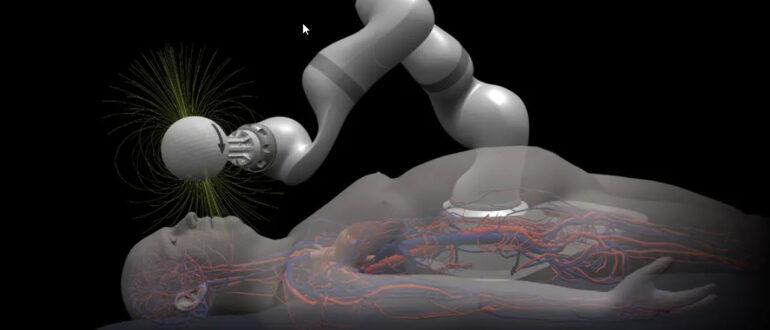

How about this; imagine a soft, hair-thin thread being steered through the twisting blood vessels of the brain by a magnet held outside the skull, clearing the clot that caused a stroke. Science fiction, right?! But amazingly, it’s being built right now, by a team at MIT and a spinout called Magnendo led by Dr Yoonho Kim. And it could change how the most severe strokes are treated, and crucially, where they can be treated.
As you may know, when a large clot blocks one of the major arteries supplying the brain, the treatment is a thrombectomy: a surgeon threads a thin guidewire up through the blood vessels, from an artery in the groin or wrist all the way to the brain, then passes a catheter over it to pull the clot out. It’s one of the most effective treatments in all of stroke medicine. The hard part is the journey. The brain’s vessels are narrow, winding and fiendishly awkward to navigate, and steering a passive wire around those bends by hand takes real skill, real time, and carries a genuine risk of damaging a vessel wall along the way.
Magnendo’s answer grew out of years of research at MIT into what the team call ferromagnetic soft continuum robots. The guidewire has tiny magnetic particles built into a soft polymer tip, so instead of being pushed and twisted by hand, it’s steered from outside the body by a magnet mounted on a robotic arm. Tilt the magnet, and the tip follows the magnetic field around even the sharpest corner. In their earlier work, published in Science Robotics, the team showed the wire threading through a life-sized silicone model of the brain’s vessels, making one acute-angled turn after another to reach a series of aneurysms.. the wire is actually as thin and flexible as a conventional neurovascular guidewire, but where a standard wire is passive, this one actively steers itself toward the target.
The approach is posited to be able shorten the navigation stage of the procedure by 10 minutes or more in a typical case, and up to 30 minutes in a complex one, which is critical stuff when brain tissue is dying by the minute. In preclinical testing it reached hard-to-reach spots faster and more consistently, and, tellingly, it narrowed the gap between more and less experienced operators. The team has now been backed to develop the system further, with the longer-term aim of it navigating largely on its own, guided by live imaging and AI, so that a surgeon supervises rather than manually threads every millimetre.
So what could this mean for us as survivors and families? I think first about speed. Every minute a major artery stays blocked, more of the brain is lost, so anything that gets the clot out sooner means less damage and, very often, a better recovery to build on afterwards. But the bigger prize is access. Thrombectomy is brilliant, yet right now it’s only offered at a small number of specialist centres, because it needs a highly trained expert on hand, and many people who could benefit live too far from one to reach it in time. A robot that can do the difficult navigation, and could one day be operated remotely, might bring this treatment within reach of far more hospitals, so that where you happen to live weighs less heavily on whether you get it.
This is really early-stage work; larger trials and a long road through regulation lie ahead before any of it becomes routine. But the direction is a hopeful one: faster, safer clot removal, potentially available in many more places, for many more people. And obviously, the less brain tissue lost in those first crucial hours, the more there is to work with in rehabilitation afterwards… sounds good to us at ARNI Stroke Rehab… what’s your view?