
BOTOX never did much for your spasticity? Or never worked as well as you hoped? Now there is a longer-lasting NHS-available alternative that a number of ARNI survivors have tried and rated positively. Cryoneurolysis has been used in medicine since the 1970s for sensory pain management; in 2018 researchers adapted it to target the motor nerves driving spasticity specifically, and by January 2024 Oxford University Hospitals NHS Foundation Trust had established a routine cryoneurolysis service at the Oxford Centre for Enablement, accepting GP and consultant referrals from anywhere in the UK. Botulinum toxin has a dose ceiling, a duration limit of around 3 months, and can develop tachyphylaxis, diminishing response with repeated injections over time; cryoneurolysis has none of those constraints, and its duration of effect of 6 to 12 months from a single treatment is one of its most practical advantages.
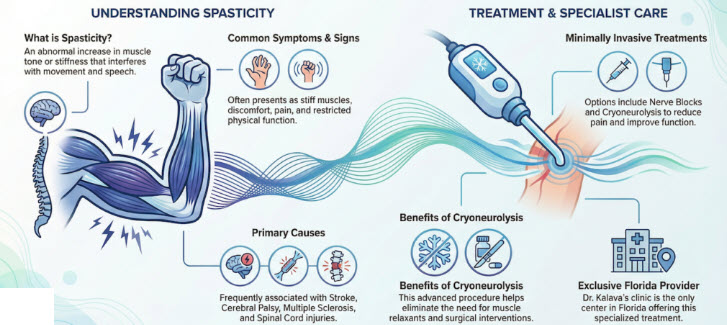
The procedure uses a handheld probe to freeze targeted nerve fibres to around -88°C, temporarily halting the signals driving spasticity while leaving the endoneurium, the nerve’s structure, intact; natural regeneration follows over 6 to 9 months. A diagnostic nerve block with local anaesthetic is performed first; if your muscle relaxes and passive mobility improves, you’re confirmed as a candidate, and the cryoprobe is then guided to the precise motor nerve using ultrasound and electrical stimulation so surrounding tissue is unaffected.
The positive evidence for the intervention seems to building quite consistently, but is still primarily case series rather than large-scale RCTs. For example, a feasibility case series published in Neurology International in April 2026, treating three adults with chronic post-stroke hemiparesis, found MAS scores decreased by at least 2 points in targeted patterns with improvements sustained at 6 months and no serious adverse events. A larger 2025 study of 59 participants with plateaued or refractory upper limb spasticity found significant improvements at 12 months in shoulder abduction (+9.7°), shoulder flexion (+8.1°) and elbow extension (+21.3°), alongside MAS reductions of 2.0 points for shoulder abduction and 1.7 for shoulder flexion… average daily pain, participant satisfaction and upper limb disability all improved. A January 2026 case in Neurology International documented a stroke survivor 12 years post-injury with an implanted FES device; targeted sequential cryoneurolysis improved his gait deviation index beyond minimal detectable difference thresholds – confirming for the first time that cryoneurolysis is fully compatible with implanted FES devices.
In Luxembourg, the spastiCRYO-LL trial received ethics committee approval in April 2024 and is generating the first quantitative gait-laboratory evidence for cryoneurolysis at scale. In Canada, a mechanistic pilot study at Parkwood Institute is targeting 25 stroke patients to characterise neuroplasticity effects via TMS, fMRI and near-infrared spectroscopy – testing whether the controlled nerve disruption cryoneurolysis creates may itself trigger neuroplastic reorganisation beyond simple tone reduction. In the UK it’s available at Oxford University Hospitals, the National Hospital for Neurology and Neurosurgery at Queen Square (UCLH) and St George’s University Hospitals. Your GP, stroke physician or neurologist must submit a formal referral.