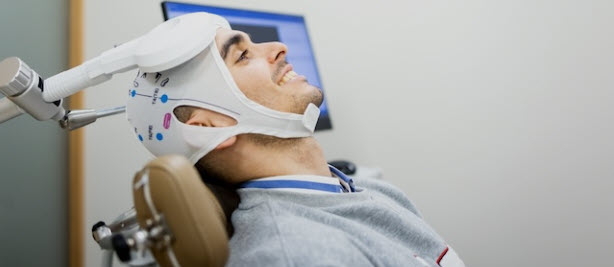
If you’ve come across transcranial magnetic stimulation (rTMS) as a possible (clinical) add-on to stroke rehabilitation, an interesting review published in July 2026 in the journal Brain Sciences, led by Marcin Karol Setlak and colleagues at the Medical University of Silesia in Poland, draws a careful line between what the tech can and cannot yet do. rTMS is a non-invasive way of changing the excitability of the brain’s motor and language networks; the idea is not to replace rehabilitation but to prime the affected area so that the physiotherapy or speech work you do afterwards lands more effectively. The review’s focus is a more precise version of it; neuronavigated rTMS (nrTMS)… which links the stimulation to your own MRI scan and tracks the coil position in real time.
So, conventional rTMS is usually aimed using scalp landmarks or standard coordinate systems, which give only a rough approximation of the cortical target underneath… and after a stroke, the lesion, the surrounding reorganisation and any change in brain shape can shift the relationship between the scalp and the region you want to stimulate. So two patients treated on the same nominal protocol can end up with stimulation over different targets. Neuronavigation reduces that uncertainty; the target is defined on the patient’s own MRI, the coil position and angle are monitored during stimulation, and the same target can be reproduced session after session. When rTMS is delivered over many sessions alongside motor training, that reproducibility matters, because small differences in coil placement otherwise add up.
Stroke is the most studied use of rTMS in rehabilitation, mostly for upper-limb motor recovery, but also for aphasia, neglect and dysphagia. Two broad strategies are common; low-frequency stimulation (around 1 Hz) to the undamaged hemisphere to reduce its inhibitory influence, or high-frequency stimulation to the damaged hemisphere to boost its activity. Both rest on the interhemispheric imbalance model, but the review is clear that neither should be applied mechanically… in patients with extensive damage to the corticospinal tract, boosting the lesioned side may not be enough, and in patients who rely on the other hemisphere for residual movement, suppressing it may do harm. Which strategy suits you depends on your lesion, your remaining motor output, and how far your networks have already reorganised.
Better targeting is not the same as better outcomes, and the review is direct about the difference. Neuronavigation improves the accuracy and reproducibility of where the coil sits, but it does not by itself control how far the stimulation spreads through the tissue, which depends on coil design, coil-to-cortex distance, intensity and your individual anatomy. And most of the clinical evidence supporting rTMS after stroke was gathered using conventional, non-navigated protocols. So its specific superiority over standard rTMS in stroke recovery has not yet been shown in controlled trials.
The authors call nrTMS a precision-enhancing tool rather than a treatment in its own right. rTMS in general is available in some UK centres for selected uses, but neuronavigated protocols for stroke rehabilitation remain specialised and investigational, held back by equipment cost, the need for recent MRI, planning time, operator training, and close teamwork between neurologists, physiotherapists and neurophysiology teams. Routine NHS use for stroke is some way off and depends on trials showing the added precision produces real functional gains. At ARNI, the ARNI Instructors and I work on the principle that any priming intervention only counts if the rehabilitation that follows is intensive and task-specific; nrTMS is worth following, but the training that comes after it is still what does the work.