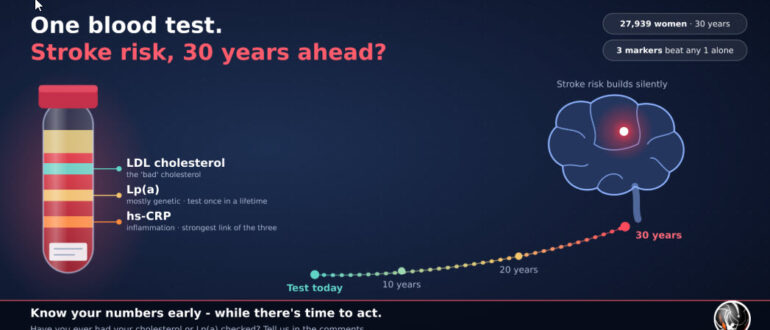

Stroke risk in any of us can build without sign, often for decades, with no outward markers until the event itself. A new study has found that a single blood test, taken years before anything happens, can flag who’s most at risk. Researchers at Brigham and Women’s Hospital in Boston, led by Professor Paul Ridker, measured three markers in the blood of 27,939 initially healthy American women and then followed them for a full 30 years. The paper was published in the New England Journal of Medicine in 2024, with a separate stroke-specific analysis in Lancet Neurology the following year.
The three markers are LDL cholesterol (the ‘bad’ cholesterol already measured in a standard lipid panel), lipoprotein(a), or Lp(a), a largely genetic lipid particle rarely tested in the UK – and high-sensitivity CRP (hs-CRP), which measures low-grade inflammation in the blood vessels. Each marker reflects a different disease process; cholesterol and Lp(a) drive the build-up of fatty plaque… while CRP tracksvascular inflammation.
Over the 30 years, a total of 3,662 of the women had a first major cardiovascular event. So comparing the highest fifth of each marker against the lowest fifth, the adjusted risk of a major event was raised by a factor of 1.70 for hs-CRP, 1.36 for LDL cholesterol, and 1.33 for Lp(a). The inflammation marker, hs-CRP, was the strongest single predictor of the three, and the three measured together served to predict risk far better than any one alone.
Across 1,345 strokes over a median of nearly 28 years, elevated hs-CRP, LDL cholesterol and Lp(a) – individually and in combination… were associated with the 30-year risk of ischaemic stroke (which accounts for the majority of cases). The study found that women with the most elevated levels were 3.7 times more likely to have a stroke across the follow-up. As this was a study of women only, the precise figures can’t be transferred to men… although the same three markers are relevant to both.
UK data also shows this in the UK Biobank, raised Lp(a) (above 125 nmol/L) was found in 11.1% of participants, roughly one adult in nine, and was associated with an increased risk of ischaemic stroke, though not of haemorrhagic stroke.
Two of these three markers are rarely measured in routine UK practice; LDL cholesterol is standard, but Lp(a) is seldom tested on the NHS and hs-CRP isn’t part of everyday cardiovascular screening. Lp(a) is almost entirely determined by your genes, stays constant through life, and needs measuring only once. HEART UK and the European Atherosclerosis Society now recommend that every adult has their Lp(a) checked at least once, so that high-risk people can be identified early. A normal cholesterol result does not rule out a raised Lp(a) or hs-CRP.
The proposed advantage of all this is that knowing your risk at 40 or 50 (rather than discovering it via a stroke at 70), leaves decades in which one can improve ones lifestyle choices to optimise ones blood pressure, weight, activity levels etc and through newer drugs being developed specifically to lower Lp(a).
So, if stroke or heart disease runs in your family, why not ask your GP when you next see him/her about Lp(a) and inflammation testing? Really, the earlier your risk for stroke is found, the more you can do to try and prevent it 😉