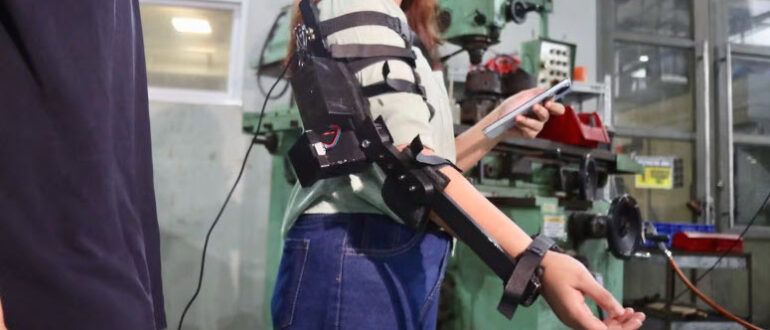

OrthoFlex is a motor-driven elbow exoskeleton built by two University of the Philippines Diliman graduates, Jabez Bote and Ada Koreen Bacay, and named national runner-up in the 2026 James Dyson Award for the Philippines. Its calculated retail cost is about £130,whereas other home and consumer rehab devices like motorised passive-movement arm trainers, lower-cost rehab gloves, home FES units can start from £350 – and of course clinical exoskeletons start from several thousand pounds to the tens of thousands.
So, as you can see, it targets one joint and one movement; flexion and extension of the elbow, ie bending and straightening the arm. The stroke survivor’s upper arm, forearm and wrist are secured with Velcro cuffs, the device is powered up and paired to a smartphone over Bluetooth, and the user or carer selects flexion or extension through a companion app. A stepper motor drives the elbow through a mechanically limited arc of 0 to 135 degrees, soo it delivers consistent, motor-assisted repetitive elbow practice. OrthoFlex uses a stepper motor driving the joint directly, which is about the cheapest and most easy-to-repair way to move a limb through a set arc.
Much recent academic elbow-exoskeleton work has gone the other way of course, towards sophistication Eg NEUROExos powered elbow exoskeleton, series-elastic cable-driven designs that place compliant actuators along the line of the biceps and triceps, shape-memory-alloy-wire actuators chosen for silent, lightweight operation, and twisted-string actuators that mimic muscle contraction. Those can be back-drivable and compliant, and can run assist-as-needed control that yields to the survivor’s own effort rather than forcing the limb. Each of those refinements adds cost, parts, calibration and fragility. OrthoFlex uses a stepper motor and his/her phone controls the interface work
Two design decisions stand out as rather sensible. The first is the mechanical limit on the range of movement. Rather than trusting software to stop the motor at a safe angle, OrthoFlex caps the arc physically at 0 to 135 degrees; which is good, as the device acts on a stroke-affected joint (which may have spasticity, contracture or altered sensation) So that physical ceiling is a sound, inexpensive safety measure. The second is field-serviceability; the motor housing and cuffs are screwed rather than glued, so worn straps or a failed motor can be replaced part-by-part rather than scrapping the whole unit. Where there is no service centre to post the device back to,home-repairability may be necessary
Set against devices this blog has covered before, the contrast is clear. The VilPower from Vilje Bionics is a whole-arm exoskeleton; ReWalk’s ReStore is a soft exosuit using Bowden-cable actuation to assist the ankle in gait; Kenneth Fong’s powered rehab skateboard at Hong Kong PolyU uses a torque sensor to read the patient’s effort in real time and adjust. All are more capable than OrthoFlex, and all are more expensive and more complex. OrthoFlex competes on access, not capability. Its nearest conceptual cousin is actually the pretty cool open-source work in the field, such as OpenSEA, a 3D-printed series-elastic elbow actuator released openly to lower the barrier to rehabilitation robotics.
This is only a prototype; it of course now needs development and clinical evaluation for safety, usability and whether it produces measurable functional gain rather than simply passive movement alone. The more expensive devices can sense and respond to the patient’s own effort; whether a device this realitevely simple can survivors usefully and actively engaged can only be established by research trial… let’s see what happens.