Most stroke survivors experience ups and downs during their recovery.
You may find it helpful to keep a log of your activities each day, progress, and energy levels. That way, if you experience a sign of regression after stroke, you can look to see if any patterns emerge.
For example, you may “regress” on days after rigorous activity and improve the next day. Once you see the pattern, you may not consider it regression. Instead, it’s a sign that you either pushed too hard or that the body is healing.
By identifying patterns, you can keep your mind at ease whenever it seems like you’re regressing after stroke. When in doubt, always see a doctor! It’s better to be safe than sorry.
www.arni.co.uk
#neurorehab #arnistrokerehab #neuroplasticity #strokerehabilitation #strokeexercise #strokerehab #strokesurvivorscan #strokerecovery #ARNIstrokerehab
... See MoreSee Less
Dedicate a space in your home as your place to train. The best reason for training at home is that when you're finished you're back home already with no need to fiddle about getting changed or working out how to get there and back.
www.ar#neurorehabn#strokerehabt#ARNIstrokerehabt#strokeexercisek#neuroplasticityp#StrokeRehabilitationbilitation
... See MoreSee Less
Approximately 40% of stroke survivors experience this difficulty: to comprehend or produce spoken or written language caused by a cerebrovascular accident. In half of these cases the language impairment still persists one year post-stroke. Aphasia has wide-ranging effects on the ability to function and quality of life of stroke survivors and easily leads to social isolation.
If you need help, ARNI SLT Telerehab can now help YOU, right now, wherever you are in the world!
The latest evidence shows clearly that you can conquer aphasia very successfully with the help of speech and language therapy.
And it also shows that SLT Telerehab is just as effective as in-person, face to face treatment.
We have a team of highly experienced low-cost specialist SLTs (all post-grads from Universities such as UCL, the University of Cape Town etc) who are available to help you right now, in your home, via Zoom. You get a one to one hourly service, based around your diary needs, from the comfort of your own home, with a highly experienced specialist speech and language therapist. Please enquire to arni.uk.com/get-remote-speech-language-help-now/ !
#aphasia #StrokeSurvivors #strokerecovery #StrokeRehabilitation #strokerehab #aphasiaawareness #neurorehabilitation #arni #exerciseafterstroke #strokeexercise #strokerecoveryexercises #neuroplasticity #ARNIstrokerehab
www.arni.co.uk
... See MoreSee Less
Dr Tom says 'Do what you gotta do. And best to bin the word ‘therapy'; leave that to the professionals. Therapy largely describes ‘being done unto you’ rather than ‘you doing it’. You needed it badly in hospital and may well still need it for many critical areas. But equally it may not suitable as a substitute for consistent retraining, if you’re one of those lucky people who is now ambulant (albeit perhaps with some support). One of the biggest keys to progress is to understand that everyday active retraining, even if you’re very elderly, is the zone you need to be in. It doesn’t have to be hugely vigorous at all. It just needs to be suitable for you and above all, consistent'. ;;)
www.arni.co.uk
#strokeexercise #neurorehabilitation #strokerehab #arnistrokerehab #strokerecovery #strokerehabilitation #neurorehab #neuroplasticity #strokerecoveryexercises
... See MoreSee Less
Stroke is the number 1 cause of disability in the UK, and someone has a stroke every 5 minutes. 4 out of 5 families will be touched by stroke at some point. ARNI (Action for Rehabilitation from Neurological Injury) UK Stroke Rehab Charity helps people of all ages who have suffered strokes, to recover in the community. To do this for each person, it matches survivors up with one of our 140 qualified and insured specialist neuro-exercise instructors who are then able to support the person at their home once therapy finishes, often due to time & resources.
ARNI Instructors assist survivors with the performance of functional task practice, physical coping strategies & resistance training. For example, they teach an innovative method for people with one virtually un-usable arm and weak leg to get down to and up from the floor safely and quickly without support from a chair or another person, thereby reducing the fear of falling -and also reducing the need to carry a stick. ARNI Charity also offers a comprehensive speech and language service, helping with communication, dysphagia & cognition.
www.arni.co.uk #exerciseafterstroke #neurorehabilitation #strokerehabilitation #strokeexercise #strokerecoveryexercises #strokerecovery #strokerehab #neuroplasticity #neurorehab
... See MoreSee Less
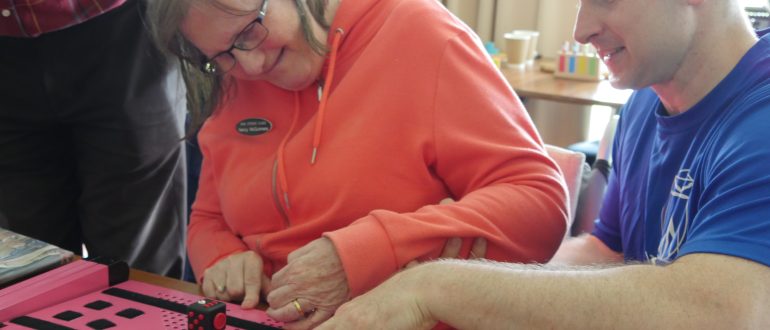
Lifting a book placed between your thumb and fingers is just one example of pinch gripping and release attempts you can try. Here, you are going to try to pinch a book, hold it up and move it about in space in the shape of a large cross and then release it. Stroke survivors with spasticity must work on finger and thumb relaxation in lots of ways.
If you need some help we have trainers throughout the country. Call us on 0203 053 0111 or email support@arni.uk.com to find out if there's one near you who can help you with your recovery.
www.arni.co.#strokerecoveryo#neuroplasticityi#strokerehabr#neurorehabr#arnistrokecharitya#strokeexerciser#arnistroketroke
... See MoreSee Less
Do you get low back pain since your stroke? If so, you're in a very big club - please tell us about it and how you deal with it in the comments below 🧠💢
Back pain is one of the most common things survivors put up with, yet it gets far far attention than paresis or aphasia. The numbers are also REALLY high and climbing for a simple reason; more people survive stroke and live far longer with its effects, so more of us carry these loads, for more years...
Across the research, around a third of stroke survivors report ongoing pain, and in some groups it's over half. And what's worse, it shows that musculoskeletal pain, including the low back, tends to climb in the months and years after a stroke rather than settle down. This factor shows up worldwide btw, from UK and Scandinavian studies to work in the US, Thailand and Nigeria.
Why so common? Well, obviously a stroke will throw your mechanics out; you load unevenly to protect your weak side, your gait changes, your trunk muscles weaken, and your posture is uneven.
On top of that, many survivors are far more immobile than they were, sitting for long stretches, and often in a wheelchair for much of the day; and prolonged sitting is one of the hardest things on the lower back. Add spasticity pulling you out of line, and your lower spine working overtime/straining... which can be a perfect storm.
What do most people do about it? Most reach for painkillers, usually paracetamol, ibuprofen or naproxen, and for nerve-related pain, amitriptyline, gabapentin or pregabalin; all of which dull the pain but change nothing underneath and bring side-effects that can be often just as bad as the pain!
As someone who's had vertebrogenic back pain (pain from the vertebrae and worn structures of the spine itself) for 5 years now. The only thing that actually helps is continuing to train, without lifting too heavy (keeping the hips and back mobile, bracing very carefully whilst setting up for a set etc).
ARNI Stroke Rehab asks; how are you dealing with/coping with back pain? How did it happen for you? And what makes it feel bett#ARNIstrokerehab.#strokerecoverye#BackPaink#strokesurvivorP#chronicpainurvivor #ChronicPain
... See MoreSee Less
Could letting your less-affected (good) arm 'teach' your more-affected (bad) arm be the 'future' of stroke rehab? 🧠🤖 Obviously so many do this without stroke tech, but can tech work WITH this?
Rice University in Texas are testing a full-arm wearable exoskeleton, worn on both arms at once, that maps the movement of your stronger arm onto your weaker one, joint by joint. Basically, instead of a machine dragging your affected arm through a movement, your own good arm drives it in real time.
As you know, many rehab robots work by moving your more-affected limb for you while you sit there fairly disengaged. And obvs your brain doesn't rebuild much when it isn't doing the work itself.
As lead researcher Keya Ghonasgi puts it, being moved by a machine is a bit like trying to learn tennis by having a coach move your arm for you. This device does the opposite; it still supports you, but it makes you drive the movement yourself, which is much closer to how the brain actually relearns...
The team wired people up with EEG (brain activity) and EMG (muscle activity) to see whether the brain is more engaged in this 'self-driven' mode than in the passive one. Because the exoskeleton works joint by joint, they also think it could rebuild cleaner joint control and cut compensation habits (eg, over-using the shoulder) that so often leads to fatigue and injury furter on down the line.
Now, the where and when; t's US-based and lab-only for now, with no product and no timeline yet, so we're talking years away from any clinic, let alone the NHS. ARNI Stroke Rehab & Recovery says: we know the principle here is spot on, and it's one we touch on constantly; that 'support' is fine, but YOU have to be the one doing the work for the brain to change.
Good to see the tech being built around this idea at last… IN THE MEANTIME, using the good hand to encourage the bad hand is, in the ARNI Stroke Bible (Successful Stroke Survivor by Tom Balchin), called the 'minimal assists'. Read more about it in there www.strokesolutions.co.uk/product/successful-stroke-survivor-manual/
#ARNIStrokeRehab #StrokeRecovery #StrokeRehabilitation #RehabTech #Neuroplasticity
... See MoreSee Less