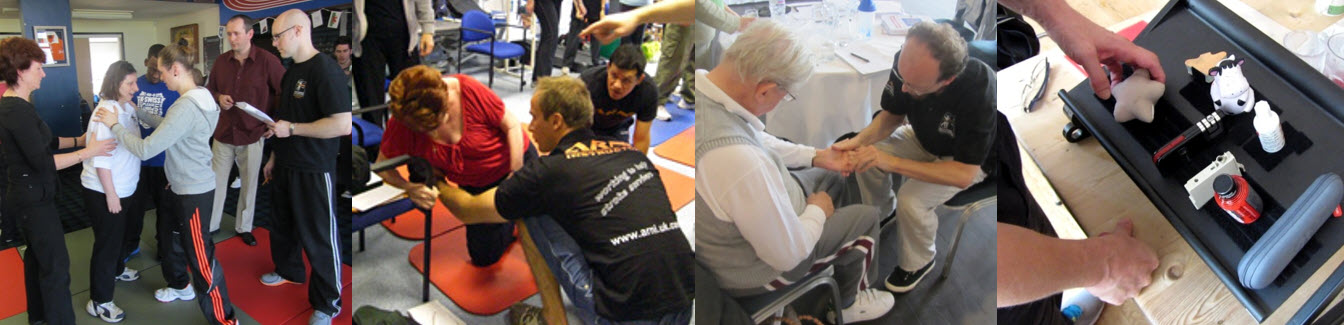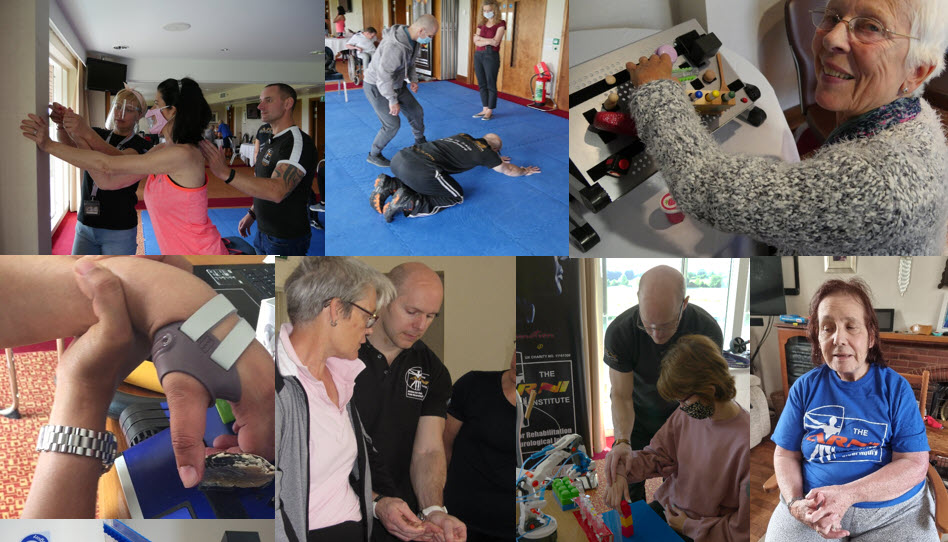
Four assessments that truly capture stroke recovery progress! Dr Tom at ARNI Stroke Rehab UK has carefully chosen four outcome measures for use in ARNI stroke survivors' Training Logbooks, to be repeated every 12 weeks, so ARNI Instructors and survivors can track what's improving, what's not, and why.
The Stroke Impact Scale (SIS) is introduced to all ARNI specialists from the outset during their ARNI Functional Rehab after Stroke Accreditation; it covers strength, memory, emotion, communication, ADLs, mobility and quality of life, giving both trainer and survivor a real picture of how stroke is affecting daily living.
The Chedoke Arm and Hand Activity Inventory (CAHAI) is taught alongside it from day one; it assesses functional use of the affected arm and hand across nine real-life tasks... opening a jar, doing up buttons and more - producing a score out of 63 that tells you what your upper limb can actually do...
Together the SIS and CAHAI form a really strong pairing. Once students are established, the Rivermead Mobility Scale (RMS) comes in, measuring mobility across 15 tasks from turning over in bed through to running... and Dr Tom has just started introducing instructors to the Fatigue Severity Scale (FSS), developed by Krupp et al, because us survivors know that post-stroke fatigue is one of the most debilitating and underassessed sequelae of stroke and it's about time it was measured properly.
Together these four cover the full landscape of recovery without overlap; upper limb function, mobility, whole-life impact and fatigue, and no single measure could do that alone. ARNI Stroke Rehab & Recovery says: these are the evidence base that shows survivors, families and commissioners what ARNI training is actually achieving - and every ARNI instructor is trained to use them by Dr Tom and his staff with care πͺπ§ πβ€οΈ
www.arni.uk.com
#ARNIStrokeRehab #StrokeRehabilitation #StrokeRecovery #OutcomeMeasures #StrokeAwareness
... See MoreSee Less
POST STROKE RECOVERY AND REHABILITATION -Neuroplasticity allows us to compensate for irreparably damaged neural pathways by strengthening or re-routing remaining ones. The more you use these pathways, your brain will respond by upgrading them so that theyβre more efficient at handling the traffic and the quicker the information is sent. The more the pathways (or βroadsβ) are used, the more adequately functional a task, ability or skill may seem to become.
Have a think about this; recovery is a journey. Rehabilitation is the road. Re-training is the vehicle and YOU are the driver. Youβve got a destination to go to, but itβs an on-going one,
If you need some help with your recovery call us on 0203 053 0111 or email support@arni.uk.com to find out if there's a trainer near you.
www.arni.uk.com
#strokerecovery #strokerehabilitation #neurorehab #neuroplasticity #neurorehabilitation #strokeexercise #exerciseafterstroke #strokerecoveryexercises #strokesurvivorscan
... See MoreSee Less
Such as great review!
This is the most wonderful book. As stroke is one of the biggest killers in UK, it is an essential book to have in any household. The book takes you from 'soup-to-nuts', including a section which discusses risk factors. It is interesting, easy to read, practical and relevant. It really is a must-have companion for stroke survivors and their families, carers and medical professionals.
It is extremely positive and this is what stroke survivors want and need. It will give great hope to those who find themselves thinking that they have little future, helping them to get back on the right track, and enabling them to make huge strides back to their former selves. Tom Balchin has lived this life and he now provides others with confidence and great hope! I also love the way that it emulates what ARNI therapists practise.
I cannot recommend this book highly enough. Thank you so much Tom - this fantastic book will make a huge difference to stroke survivors and their families all over the globe.
www.strokesolutions.co.uk/product/had-a-stroke-now-w#strokerehabilitationb#strokerecoveryk#neuroplasticityp#stroket#neurorehabneurorehab
... See MoreSee Less
A study published in the journal Nutrients has modelled what would happen if adults aged 30 to 79 increased their average daily milk intake to the nationally recommended 180 grams, roughly equivalent to two dairy servings per day, and the projected results are striking.
Across a ten year period, meeting this target was estimated to reduce overall stroke incidence and stroke related mortalityby around 7%, with some subgroups seeing reductions of up to 10.6%. Stroke related national healthcare expenditure was projected to fall by approximately 5.1%, with subgroup savings reaching as high as 8.5%, suggesting that even modest, achievable dietary shifts could have meaningful population level consequences.
The researchers used a Markov model to simulate these outcomes, a method commonly used in health economics to project long term disease burden based on changing risk factors over time. Milk contains calcium, magnesium and potassium, all of which have been proposed as potential contributors to cardiovascular protection, though the precise biological mechanisms linking dairy intake to reduced stroke risk are not yet fully understood.
While this research is based on Japanese population data and dietary patterns, the principles around diet as a modifiable stroke risk factor are broadly relevant and will resonate with stroke communities worldwide. Work of this kind adds important weight to the case for dietary intervention as part of stroke prevention strategy, sitting alongside exercise, medication and lifestyle management.
It is worth noting that translating population modelling studies into routine clinical or public health guidance in the UK typically takes several years, pending replication in UK cohorts and review by bodies such as NICE and the British Dietetic Association. ARNI Stroke Rehab & Recovery says: evidence like this reinforces how much lifestyle factors including diet matter in stroke prevention and recovery, and we will continue to follow developments in this area closely as the science evolves πͺπ₯π§ β€οΈ
www.arni.uk.com
#ARNIStrokeRehab #StrokePrevention #StrokeRecovery #DietAndStroke #StrokeAwareness
... See MoreSee Less
Neuromuscular stimulation, also called functional electric stimulation, (commonly abbreviated as FES) is the clinical application of a small electric current to the intact nerves of your body, in order to trigger a muscle contraction and increase cortical excitability during training. This contraction is then incorporated into a functional activity like walking. A clear distinction needs to be made between Therapeutic Stimulation and Functional Stimulation. The former is an exercise where you relax whilst the stimulation works on its own. FES on the other hand, incorporates this elicited muscle movement into your everyday activities, like standing, walking, reaching out, etc. Like CIMT, it is probably most suitable to try if you possess some wrist and hand movements. Iβm not aware of anyone trying to use CIMT and FES protocols together. I canβt see why FES couldnβt be built into a CIMT routine.
From The Successful Stroke Survivor book by Tom Balchin.
www.arni.uk.com
#strokesurvivorscan #strokeexercise #strokerehabilitation #exerciseafterstroke #strokerehab #neurorehabilitation #neuroplasticity #strokerecovery #strokerecoveryexercises
... See MoreSee Less
IMPORTANT INFORMATION π
The most important person participating in your recovery is You:)!
The brain is flexible due to neuroplasticity and in certain circumstances, the brain is radically rearranged π
It is very important:
- repetitive exercises ,
-task-specific exercises,
- lots of practice ,
-cardio exercises ,
-strengthening exercises,
Call us on 0203 053 0111 or email support@arni.uk.com if you want to know if there's a trainer near you who can help you with your recovery.
www.arni.uk.#StrokeRehabr#strokerecoveryo#neurorehabr#neurorehabilitationa#strokesurvivorscanr#exerciseafterstroket#strokeexerciser#strokerehabilitationa#strokerecoveryexercisesc#neuroplasticityi#ARNIstrokerehabrehab
... See MoreSee Less
Our wonderful ARNI Instructor, Jo, passed away last night.
She was a total warrior...
And let none of us know, even me, that at the time she received our rounder card in November, signed by so many ARNI Instructors (50 of you; thank you all of you), that she was facing a second tumour,
Sadly when they removed her brain tumour, they had found a second much more aggressive one in a scan, just before surgery.
They were unable to remove it and she was too poorly to tolerate treatments either.
She was an ARNI Instructor for 10 years this year, and I will MISS HER...
Very much...
Roz (Harry's Mum), told me the news today (Roz, Jonathan and Harry Baker so kindly put Betty, Jo's sister up for 10 weeks at their house to facilitate her to be with Jo). Thank you to the Baker family; Harry is training at ARNI just behind Jo in this picture, coincidentally...
... See MoreSee Less
Passive range of motion exercises are good way to activate neuroplasticity when you have difficulty moving a limb. It's done by someone helping by moving your affected limbs through their full range. You can also do passive exercises yourself by using your unaffected side to move your affected ones. This will help your recovery by by sparking neuroplasticity.
And remember we have trainers throughout the country who can help you. Call us on 0203 053 0111 or email support@arni.uk.com to find out if there's one near you.
www.ar#StrokeRehabt#strokerecoveryexercisesy#exerciseafterstrokef#strokerehabilitationb#strokeexercisek#strokerecoveryk#neurorehabilitationbilitation
... See MoreSee Less
One Comment
Hi , Iβm interested in qualifying as ARN instructor.
Please can you forward information , dates & price of the course. Many thanks