Stroke can cause a problem called ‘lateropulson’ – which basically causes you to lean hard over to one side, pushing away from your stronger arm and unable to feel that you’re tilted at all – it’s horrible – and is much more common than most people realise. After a right-hemisphere stroke it affects around two-thirds of people early on, and almost half a little later. The mechanism is interesting; stroke can leave the brain perceiving a tilted internal picture of what ‘upright’ is – so the person then lines their own body up with that wrong picture – so, actively pushing toward their weaker side and resisting anyone who tries to straighten them – also, usually with no awareness they’re off-vertical at all. The severe form is what used to be called “pusher syndrome.” It’s one of the biggest causes of lost mobility after a stroke and is also a major reason people fall after stroke.
A trial just underway in Grenoble in France is one of the first rehab programmes built specifically to retrain this faulty sense of vertical over a three-week programme using a hands-free walking exoskeleton called the Atalante. The device holds the body at true upright, so whenever the person’s own internal sense drifts off vertical, the exoskeleton contradicts it, and the brain is forced to fall back on real gravity information to get the task done. Because the patient’s head will stay free, that information comes mainly through the pressure and position signals from the feet, working alongside the balance organs in the inner ear.
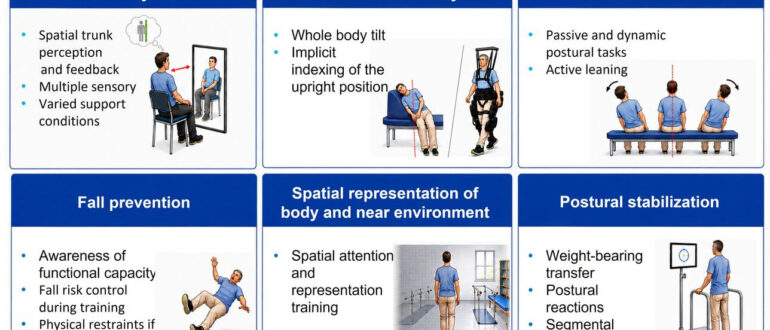
Most of the programme happens via physio though – which looks to assist awareness of the tilt using mirrors marked with vertical and horizontal lines… and with eyes shut, which (rather oddly) makes the tilt easier to feel because it takes vision out of the equation. There’s ‘whole-body tilting’ toward the opposite side, a simple and surprisingly powerful way to reset the sense of vertical for a while, along with balance and weight-transfer tasks. They also train spatial attention, because lateropulsion and spatial neglect are closely linked. Actually, lateropulsion is now thought of as a kind of neglect that affects the sense of gravity itself.
The evidence behind it is this… during ordinary rehab, improvement in lateropulsion accounts for roughly 40% of a person’s balance and gait recovery in the subacute phase. Three randomised trials have already tried exoskeleton training for it, showing an immediate effect after a single session and a clear benefit for lateropulsion and balance after two or three weeks, although one of these found it no better than training with a simpler leg brace.
It’s a small, careful proof-of-concept, three participants each acting as their own control, measured daily on where they perceive ‘vertical’ to be -offering a way to make that practice possible for survivors whose sense of what ‘upright’ means is so alterred they can’t train safely on their feet at all. It’s an area that’s been overlooked for years, so it’s great to see someone try to build a proper model of why it happens, and test it.. so let’s see what happens.