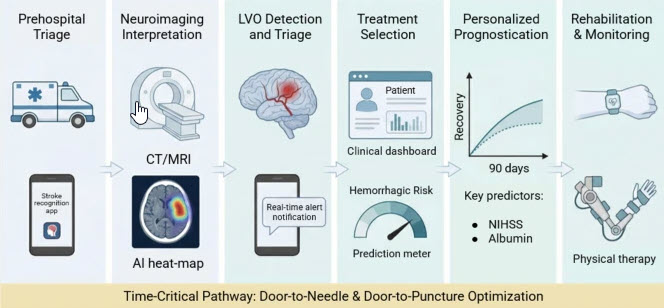
The two emergency treatments that reopen a blocked artery (thrombolysis, a clot-dissolving drug given within 4.5 hours, and thrombectomy, physical removal of the clot, up to 24 hours in selected patients) both depend on how quickly the right scan reaches the right specialist.,, and this is where AI has been targeted in stroke medicine. The software’s role is triage; the doctor still treats the stroke and makes every decision. Trained on thousands of expert-labelled scans, it receives a copy of every relevant scan automatically, analyses it within minutes, and alerts the stroke team. It flags possible bleeding on the plain CT, traces the vessels on the CT angiogram to find the large vessel occlusion that thrombectomy can remove, and on a perfusion scan maps the dead core against the still-viable penumbra, the method used to select patients in the DAWN trial that extended the thrombectomy window to 24 hours. The doctor reads every scan and examines every patient whatever the software reports.
England’s adopted this more widely than almost any other country btw. NHS England reported in December 2024 that all 107 stroke centres in England were using AI… covering around 80,000 patients a year. The largest evaluation, led by researchers in Reading and Oxford and published in The Lancet Digital Health in late 2025, drew on national audit data covering 452,952 admissions between 2019 and 2023, focusing on 26 hospitals that introduced the Brainomix system. At those hospitals the proportion of patients receiving thrombectomy rose from 2.3% to 4.6%, and among 747 transferred patients the median “door-in-door-out” time was 128 minutes with AI against 192 without it.
That study was an observational one; thrombectomy rates also rose at comparison hospitals, from 1.6% to 2.6%, so services were expanding everywhere, and staffing or capacity could account for part of it. The strongest test was an RCT from UTHealth Houston in JAMA Neurology (2023), covering 243 thrombectomy patients across four centres. It found that AI alerts cut the time from arrival to thrombectomy by about 11 minutes, while independent-living rates afterwards stayed level – which is significant, The software’s most reliable for clots in the largest front-of-brain arteries, and its accuracy falls for smaller branches, strokes at the back of the brain, and transient ischaemic attacks where the scan can look normal; a clear scan still leaves a stroke possible, so the specialist reads every one. NICE recommends three tools (e-Stroke, RapidAI and Viz) for NHS use alongside continued evidence collection. AI’s basically made the emergency phase of stroke care faster and better organised, with this country currently as one of the clearest examples of this…