Do you live with chronic back-pain pain after stroke? Please let us know in the comments below. 40 to 45% of stroke survivors do live with pain but there are no stats on those who just live with back pain too rather than more global musculoskeletal pain and CPSP... please let us know in the comments below.
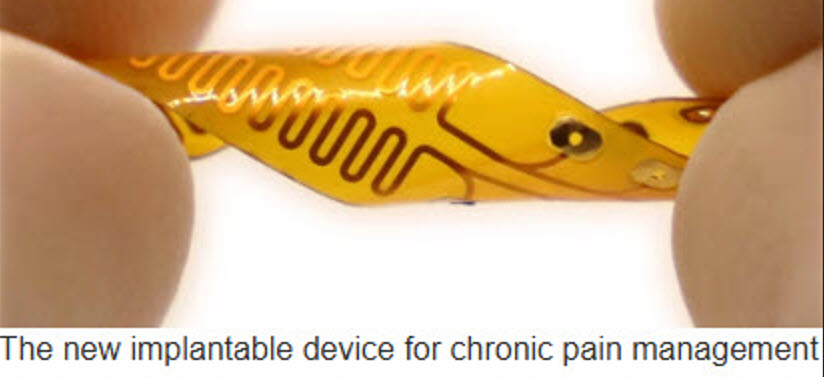
Low-back pain and dealing with limitations after stroke can be just awful. I've just been passed a paper that shows that a wireless AI implant could be the solution to pain from spasticity and chronic low-back pain going forward. If this is so, it's very significant... a watch this space thing...
Published in Nature Electronics , researchers from the Zhou Lab at the University of Southern California (USC), working with the Jun Chen Group at UCLA, have developed a small flexible wireless implant that could transform chronic pain management for stroke survivors living with spasticity and chronic low back pain.
It uses ultrasound to power itself wirelessly through the skin via a wearable transmitter... meaning no batteries, no wires and no repeated surgery. It works through the piezoelectric effect, converting ultrasound waves into electrical signals that stimulate the spinal cord and block pain signals; and it uses machine learning to adapt the stimulation in real time, personalising treatment continuously rather than delivering a fixed response.
For stroke survivors who've developed chronic low back pain through altered gait, compensatory posture or reduced mobility, this kind of drug-free self-adapting relief could reduce one of the biggest barriers to sustained rehabilitation... and unlike existing spinal cord stimulators it's affordable, minimally invasive and battery-free. In the UK, MHRA approval and NICE review would be needed before routine clinical use, a process that takes a number of years; but this is one to watch.
ARNI Stroke Rehab & Recovery says: chronic low back pain is something we hear about constantly from stroke survivors - and anything that reduces reliance on opioid medication and supports people to keep rehabilitating deserves serious attention 🧠💉🔬❤️
www.arni.uk.com
#ARNIStrokeRehab #StrokePainRelief #ChronicPainAfterStroke
... See MoreSee Less
Brain bleed plus AF: a drug dilemma soon solved? One of stroke medicine's most difficult questions is finally being properly tested: should patients who have atrial fibrillation (AF) and have already suffered a brain haemorrhage take anticoagulant medication to prevent stroke?
The ENRICH-AF trial, led by Professor Ashkan Shoamanesh of the Population Health Research Institute, is a large international randomised study across 20 countries involving 947 patients, comparing edoxaban, a direct oral anticoagulant that blocks factor Xa to reduce clot formation, against antiplatelet therapy or no treatment at all.
The dilemma is real; as you probably know, AF significantly raises ischaemic stroke risk through cardioembolism, but in someone who has already had a brain bleed, anticoagulation also risks triggering another haemorrhage, and for years most clinicians have defaulted to caution, often leaving patients underprotected.
An important safety signal has already emerged; the Data Safety Monitoring Board reviewed the first 699 patients and recommended stopping edoxaban for those whose bleed had occurred in the lobar region, due to unacceptably high rebleeding risk linked to cerebral amyloid angiopathy.
The trial continues for non-lobar brain haemorrhage patients, where the risk profile appears more favourable, and top-line results are expected at a major international scientific meeting later in 2026.
ENRICH-AF sits alongside parallel trials including PRESTIGE-AF and ASPIRE, all building the evidence base that UK clinical guidelines through NICE currently lack; routine implementation in the UK will follow review by professional bodies, likely several years after publication.
ARNI Stroke Rehab & Recovery says: this research matters enormously to stroke survivors living with AF, and we'll be following the ENRICH-AF results closely when they're presented; basically, better evidence means better, safer decisions... 🧠❤️💊🔬
www.arni.uk.com
#ARNIStrokeRehab #StrokeResearch #AtrialFibrillation #StrokePrevention #StrokeAwareness
... See MoreSee Less
Mark Scott is this near you?Our new Jarrow Stroke Support Group is meeting again this Saturday 💙
The group is run by stroke survivor Karlyn, alongside her parents Karen and Mark, creating a welcoming place for working-age and younger stroke survivors to connect.
If you’re in the area and looking to meet people who understand life after stroke, you’ll be met with friendly faces and a relaxed, supportive environment.
🗓 Saturday (3rd Saturday of the month)
⏰ 10:00 – 11:30
📍 Bilton Hall Community Centre, Taunton Avenue, Jarrow, NE32 3RT
Whether it’s your first time or you came along last month, you’ll be very welcome.
#StrokeSupport #StrokeSurvivor #NotJustTheElderly #DifferentStrokes
... See MoreSee Less
Let's talk about Shoulder Drop after stroke... subluxation is a partial (minor) dislocation of the arm at the shoulder joint that often occurs after a stroke. In most cases, extreme muscle weakness can result in the muscles not being able to hold the weight of the arm at the shoulder, resulting in the humerus (upper arm bone) dropping down out of the shoulder joint. It can also cause the shoulder blade to lose its normal position.
If your arm is affected by subluxation, you'll know about it! You may well be able to clearly see the difference in level between your more-affected and less-affected shoulder in the mirror. It’s important to protect your shoulder from injury and try to keep your more-affected arm in as normal a position as you can manage.
When resting, your more-affected arm can be kept in a comfortable position which prevents or lessens subluxation. Make sure no-one lifts you from a seated or lying position underneath your arms. This can cause damage. Instead, try learning with a therapist, as soon as you can, how to get yourself from both a seated to standing position and from the floor to standing without involving your more-affected arm much.
There is evidence that starting with a sling suspension system and conducting active shoulder exercises may be effective in reducing shoulder subluxation, improving proprioception and upper extremity function. However, after discharge, survivors often retain slings for lengthy periods in the community simply because they have no clear guidance concerning whether it’s possible to reduce (or stop) using one altogether. And if so, when to do it. Please understand that a sling won’t help you in the long run and may well hold back your recovery.
So, seek the advice of your ARNI instructor or your GP concerning how and when to reduce sling usage. Careful retraining without one is the probably the only way that you’re going to fully correct shoulder subluxation. Of all treatments, the evidence reveals that only electrical stimulation is consistently effective at reducing subluxation.
www.arni.uk.com
#ARNIStrokeRehab #Stroke #sublux
... See MoreSee Less
Sleep helps improve movement recovery after stroke by turning the short-term memories from the day into long-term memories. It also gives the brain time to rest and recharge.
Many stroke survivors can be concerned by how much they sleep after a stroke. If you find yourself sleeping lots during recovery, it’s probably a good sign.
www.arni.uk.com
#strokeexercise #strokerecoveryexercises #ARNIstrokerehab #exerciseafterstroke #neurorehabilitation #neurorehab #strokerehabilitation #strokerehab #strokerecovery #strokesurvivorscan #neuroplasticity
... See MoreSee Less
APPROPRIATE compensations are those that are necessary for the performance of a specific task in a given environment at a certain time but that do not persist once the task has been accomplished. These compensatory strategies should diminish over time.
INAPPROPRIATE compensations are those that persist beyond the completion of a task, limit other functions, or the completion of a task, limit other functions, or mask potential for further recovery.
www.arni.uk.com
#neuroplasticity #StrokeRehab #neurorehab #strokerehabilitation #strokesurvivorscan #arnistrokecharity #strokerecovery #neurorehabilitation #strokerecoveryexercises #exerciseafterstroke #strokeexercise
... See MoreSee Less
Clot busting drugs and new stroke therapies don't always mix! A study led by the University of Manchester has found that anakinra, a promising anti-inflammatory treatment for ischaemic stroke, interacts negatively with tissue plasminogen activator (tPA) - the clot busting drug already used as standard care.
The research, conducted on mice, shows that the timing of anakinra must be carefully adjusted to avoid reducing the benefits that tPA delivers. As you'll know, this matters because tPA, which dissolves blood clots to restore blood flow to the brain, is the only licensed thrombolytic treatment for ischaemic stroke in the UK, given within a 4.5 hour window after symptoms begin.
Anakinra, already licenced for rheumatoid arthritis, had shown real promise as a neuroprotective agent after stroke, making these findings all the more important before any progression to human trials. The study highlights a principle that is sometimes overlooked: new stroke therapies must be tested alongside existing standard care, not in isolation. For UK patients, routine clinical use of any combined approach remains many years away, pending larger trials and NICE review.
ARNI Stroke Rehab & Recovery says: this is exactly the kind of careful science that us stroke survivors need to know is happening; colleagues at the University of Manchester ar doing important work 🧠💊🔬❤️
www.arni.uk.com
#ARNIStrokeRehab #Stroke
... See MoreSee Less
it’s important to know how to adjust your stroke exercises to suit your ability level. With all exercises, it’s important that they are challenging enough but not too easy that it doesn’t stimulate neuroplasticity.
Whether you are starting with no movement or partial movement, neuroplasticity is always the goal. You can encourage neuroplasticity by performing high repetition of your exercises with conscious attention and your goals in mind.
Repetition is how the brain perceives the need for a function, and it rewires itself accordingly. Think: the more you use it, the more you improve it. You will see faster results if you practice every day instead of once per week.
Furthermore, paying attention to the quality of the movement and why you are doing the exercise will stimulate neuroplasticity even more.
We have trainers throughout the country who can help you with your recovery. Call us on 0203 053 0111 or email support@arni.uk.com to find out if there's one near you.
www.arni.uk.com #strokerecoveryexercises #strokesurvivorscan #strokerecovery #exerciseafterstroke #strokeexercise #strokerehab #neurorehabilitation #neuroplasticity #strokerehabilitation #neurorehab
... See MoreSee Less
As stroke survivors, we have to keep learning, keep exploring and keep innovating over the long term. A start can be made by trying to find 'what's out there' (knowledge is power) and starting to retrain, with short and longer term goals. A physio or ARNI trainer can really help here. Call us on 0203 053 0111 or email support@arni.uk.com to find out if there's a trainer near you who can help you with your recove#stroke.#strokesurvivorso#neuroplasticityo#strokerecoveryc#strokerehabilitations#strokemotivationon #strokemotivation
... See MoreSee Less