Instructor Qualification Training 18th April 2026
-
- April 18, 2026
- 0
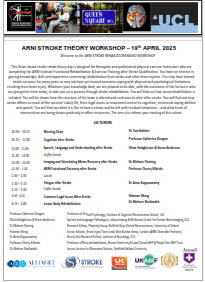 Click to view this Course’s ARNI Stroke Rehabilitation Workshop
Read More Articles on the ARNI Blog
« Instructor Qualification Training 14th March 2026 | Instructor Qualification Training 2nd May 2026 »


Have a great weekend.
www.arni.co.uk #exerciseafterstroke #strokerecovery #strokerehabilitation #strokerecoveryexercises #neurorehabilitation #neuroplasticity #strokeexercise #strokesurvivorscan #neurorehab

A testimonial on why The Successful Stroke Survivor book is the right book......Following my traumatic brain injury, I was determined and relentless to get back on the road to recovery. For guidance on the road to functional recovery and alongside my physiotherapist, this was the book for me. Tom Balchin details the latest evidence based techniques and ARNI approaches to help recovery. I found particularly useful the ways to help reduce spasticity and decline in upper limb as well as how to regain hand and finger function as well as strengthening exercises for lower limb function. Through such detailed and informative advice, married with clear illustrations you are taken through detailed text involving key concepts such as brain plasticity followed by the steps to retrain your affected limbs for the purposes of functionality. For example, to get up from the floor. If you stick with Tom's methods and practice practice practice, you are sure to see results! I even followed this with a session with Tom himself!
www.arni.co#neuroplasticityi#ARNIstrokerehabr#StrokeRehabr#strokerehabilitationa#strokesurvivorscanr#neurorehabr#strokerecoveryo#strokeexercisercise
Successful Stroke Survivor Manual – Stroke Solutions
www.strokesolutions.co.uk
This book/manual was written by a stroke survivor for stroke survivors. Part-book and part-manual for those who have suffered a stroke and reached the end of formal stroke rehabilitation therapy. The ...
If stroke survivors fail to move their muscles (either through active exercise or passive range of motion), they may develop a condition called learned non-use. This condition causes your brain to have even more difficulty paying attention to the affected muscles, therefore making it harder to rehabilitate these muscles and over-relying on your non-affected side. This is where the phrase “use it or lose it!” comes from.
www.arni.co.uk
#useitorloseit #neuroplasticity #ARNIstrokerehab #strokerehab #strokerehabilitation #strokesurvivorscan #neurorehab #strokerecovery #strokeexercise
Could a stroke rehab exoskeleton really cost about the same as a refurb Iphone?!? Two graduates in the Philippines reckon so...
Jabez Bote and Ada Koreen Bacay, from the University of the Philippines, have built a wearable device called OrthoFlex to help stroke survivors get movement back in a weak arm. And they've worked out the prototype costs around £45 to build, with a proposed retail price of around £130. Similar devices, they reckon, start at around £330. So this is an absolute fraction of the usual thing I've revealed in pasts ARNI Stroke Rehab posts about exos...
The device looks sensibly simple. It’s a motor-driven elbow exoskeleton; you strap your affected arm in, connect the power, and pick flexion or extension exercises (bending and straightening the elbow) through a phone app. The motor then guides the elbow through the reps. which, as you know, is what drives recovery.
Two things in the design are smart; it’s built to be repairable (parts can be swapped or fixed rather than binning the whole unit) - and there’s a mechanical limit to cap the range of movement, ie a physical stop so the motor can’t push the elbow too far,... a simple, cheap safety idea.
This is obvs still a prototype; it'll needs proper development and testing for safety, usability and whether it actually works in real stroke rehab - or whether it's just unwieldy and a bit rubbish.
So, can cheap and simple really be done? To my mind, yes, possibly - and this is how it could be - a) strip it to one joint, b) make it repairable c) let a phone do the 'smart' bit d) get the price down to where we can afford one ,e) make is safe and simple and f) market it to us and make it WORK for people.
Whether OrthoFlex ever ACTUALLY itself makes it through to people’s homes, who knows; but the thinking behind it is commendable, I think - esp from these young grads. What do you think?? Let me know in the comments below! ;)
www.arni.co.uk
#ARNIStrokeRehab #StrokeRecovery #Exoskeleton #StrokeRehabilitation #AssistiveTech
This is the kind of thing that I thought there would be more of in this day & age & that big Charities like the Stroke Association be involved with. Alas there are very few “whizzy” things available. Virtual reality headsets are supposed to be a good idea of stroke survivors doing their exercises. They are relatively cheap to buy but where do you get the exercise programmes from? Queens Square were doing a trial on this but due to my husbands aphasia he couldn’t participate, but why aren’t these programmes made available? It’s a constant chase to find things that work, where this should all be centrally coordinated by someone. It’s pot luck if you stumble across something. I can’t believe that there aren’t centres for Stroke survivors offering physio & exercise classes as there are for other conditions. We are left to research ourselves after 4 years of doing this for my husband I am becoming more & more disillusioned by it all.
Amazing....I hope they don't get bought out because they will be approached so that big companies can profit...
Does this trigger off your own slight muscle movements like the Myomo? Which is $60000?
Every exercise you do isn't just 'one' exercise and every workout isn't just a 'workout'. Everything you do is related. They are all just a point on a continuum that must constantly be improving. Improvement is the name of the game!
If you want some help with your recovery call us on 0203 053 0111 or email support@arni.uk.com to find out if t here's a trainer near you who can help you w#strokerehabilitationw#strokerecoveryt#ARNIstrokerehabo#neurorehabc#StrokeRehabt#arnistrokecharityh#arnistrokee#strokeexercisec#strokesurvivorscan##ARNIstrokerehabstrokesurvivorscan #ARNIstrokerehab
Exercise: Hip push-pulls
This movement is fantastic. It is a static, gross motor movement exercise which can be turned into a warm-up exercise. It resembles a deadlift movement with no weight.
Find out more about this exercise in The Successful Stroke Survivor book by Tom. Balchin
www.arni.co.uk
#neuroplasticity #strokerehabilitation #neurorehab #strokeexercise #StrokeRehab #strokesurvivorscan #strokerecovery #ARNIstrokerehab
Task-specific practice is one of the best weapons we have to help retrain the brain. I Meaning simply to train the action to be performed in a natural environment. E.G. if you wanted to lift a mug and drink from it, you take a mug and practice lifting and drinking from it, over and over again … and attempt to improve progressively and consistently. It will also ‘force’ you to practice using your more-affected limb.
Try to do MORE with your affected upper limb each day. Repeated attempts in training creates a form of practice that can potentially lead to further improvement. The ideal is to find oneself in a ‘virtuous circle’, in which spontaneous limb use and motor performance reinforce each other and re-teach your body to control the position of an affected limb.
Many survivors can be assisted to retrain by advising them to have one place and a set amount of times per week in which they devote time to retraining. I tend to promote the importance of setting up a small ‘training area’ in your house. It needs only to be a few square metres wide. With a chair and a small table with a task-board, more advanced challenge board and other small items on it.
You need to find your own task specifics and work on ‘close-simulations’. Even though they may not be as effective for motor learning as performing the actual task, and remember, we are after significant performance improvement via task practice, you can see that this approach gives you some great advantages. It keeps you in the training area, and working on-task, and keeps you safe. Outside the training area, you need to make an effort to practice tasks (or the components that you can manage), as part of your ADLs; noting any changes.
One great example: I created ‘DJ-Therapy’ to get my upper limb working. I basically made up a hugely successful paradigm which was suitable for me. How I did it is all listed in The Successful Stroke Survivor.
Making training ‘not training’ is one of the biggest secrets to getting optimal success with upper limb function. I wish more people would have a go at this. Have a think about what might be suitable for YOU to keep YOU practising and interested.
www.arni.co.uk
#neuroplasticity #ARNIstrokerehab #strokeexercise #strokerecovery #neurorehab #strokerehabilitation #strokesurvivorscan #strokerehab
Picking up things helped me ended up being able to pickup lentils. Typing this with both hands!
If you want to focus on upper body this is the upper body section of the Successful Stroke Survivor book. You'll love this aid to retraining, as you can just keep it open on the table whilst practising. Available on Kind#ARNIstrokerehabr#strokeexerciser#neuroplasticityi#neurorehabr#strokerecoveryo#StrokeRehabr#arnistrokecharitya#strokesurvivorscanr#strokearmrehabrehab
Upper Body Rehab - Self-help Resource Manual (The Successful Stroke Survivor Book 5)
www.amazon.co.uk
This book is Volume 5 in the series of 5 taken from best-selling book and manual The Successful Stroke Survivor by Tom Balchin. The 5 Volumes are all that those who have suffered a stroke and have rea...
Training with Tom online video
Real-life training on the mat with Dr Tom. He takes a stroke survivor through a training session (although an extended one in order to show you lots more things you can do). Starting with a warm-up, you will see the stroke survivor guided through a session where he is does first static exercises, gait control work, balance training, strength training and some seriou supper limb training. You will see how to put everything you’ve seen on online videos 1 to 6 into practice – and you’ll see a stroke survivor starting to work on the edges of his current ability in many areas, particularly when challenging his upper limb. This video is where many of the exercises, techniques and strategies will really come to life for you as you see how they work together, if practised carefully and with some dedication, to produce a trainee who is totally transformed in terms of action control, strength and confidence in the ability to move and function normally in society again.
www.strokesolutions.co.uk/product/training-tom-dvd/
#neurorehab #strokeexercise #strokerehabilitation #neuroplasticity #strokerehab #strokerecovery #strokesurvivorscan #neurorehabilitation #exerciseafterstroke #strokerecoveryexercises #strokeexercises #strokeexercisespecialist
HOW TO GAIN THE MOST BENEFITS FROM E-STIM FOR STROKE REHABILITATION
Combining electrical stimulation with exercise is more effective for stroke patients than just exercise alone.
While some forms of electrical stimulation are passive (involving no participation on your behalf), e-stim for stroke survivors should be active. This means you should try to engage your muscles yourself when you feel the electrical current activate.
When you are engaged in therapy exercises during e-stim, it helps to further engage the brain-muscle connection. This will in turn increase the amount of motor control you can gain back.
Exercise without electrical stimulation can still activate neuroplasticity and help stroke survivors regain movement. For maximum benefit, though, the science is clear: combining e-stim with exercise is the best way to go.
www.arni.co.uk
#strokeexercise #StrokeRehab #strokerehabilitation #strokerecovery #neurorehab #neuroplasticity #stroke #strokesurvivors #ARNIstrokerehab